Who: U.S. supermarket chains and their produce suppliers.
What: Expanded on-shelf "regenerative" labels for fruits and vegetables and new verification partnerships.
When: Update as of June 2026 (original reporting began in late 2025).
Where: National and regional supermarkets across the United States, including expanded pilots in major stores.
Why it matters: Labels aim to link shoppers to verifiable soil-health and climate-oriented farming practices while creating new value channels for growers—if verification, transparency and pricing align.
Context: from 2025 USDA pilot to broader retail tests in 2026
The USDA’s 2025 verification pilot—designed to test methods for documenting regenerative farming practices for marketing—helped catalyze retailer programs in late 2025. Between January and June 2026, retailers expanded initial pilots. By mid-2026 multiple national chains and influential regional grocers had moved beyond single-store tests to multi-store rollouts or seasonal programs tied to specific sourcing regions.
Retailers say the move responds to two pressures: consumers who increasingly expect environmental information on food, and growers who want new revenue streams for on-farm conservation. The growth has been driven as much by retail marketing strategy as by farm-level interest in documenting practices like cover cropping, reduced tillage, extended rotations and managed grazing where applicable.
What retailers and grocers are testing now
Retail pilots have diversified in 2026. Approaches now include:
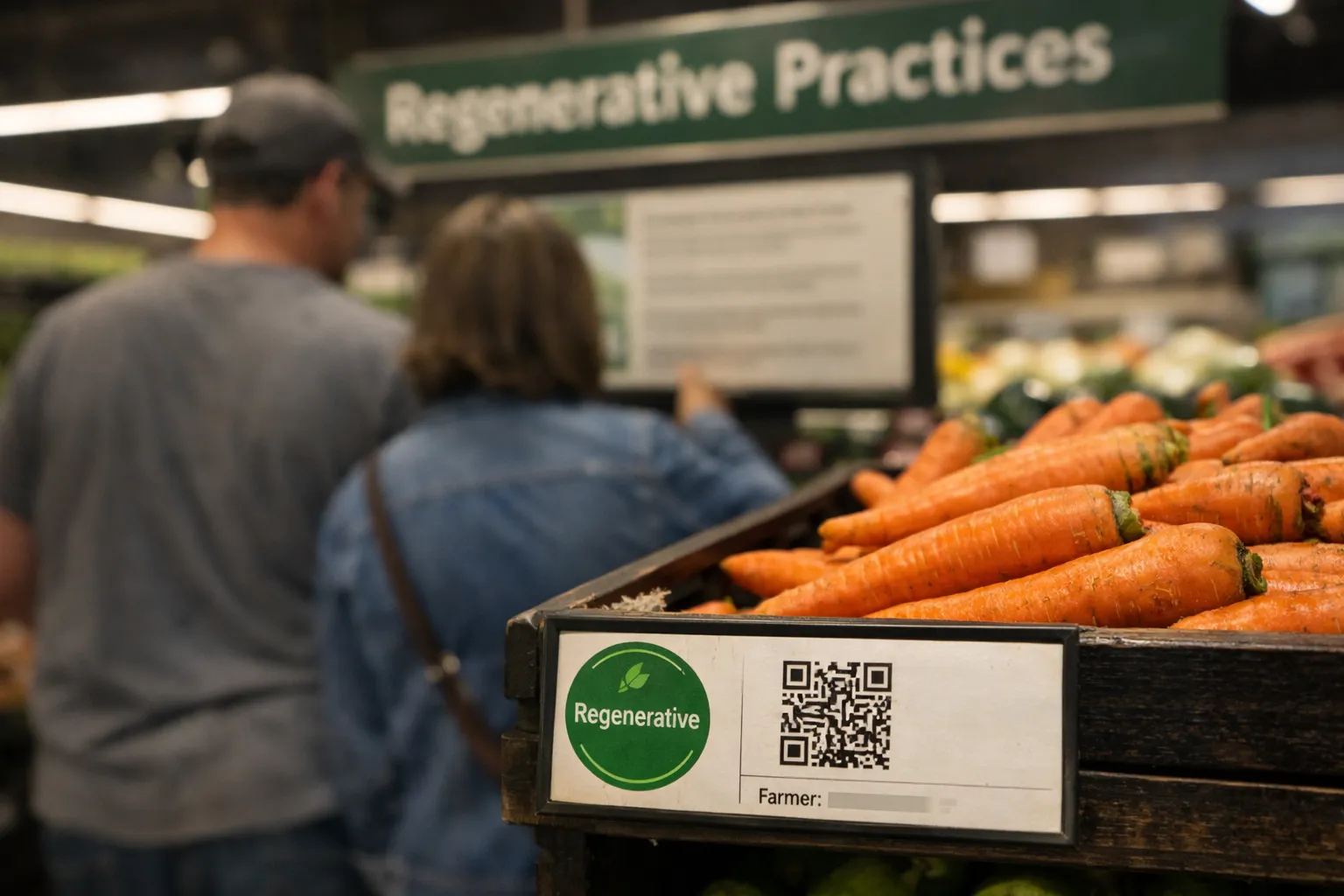
- On-shelf badges plus context: Short “Regenerative Practices” badges next to product names accompanied by succinct on-shelf language describing the practices documented for that lot or farm.
- QR-enabled traceability: QR codes that link to farmer profiles, multi-year practice logs, and summary verification reports—popular in chains prioritizing transparency to millennial and Gen Z shoppers.
- Curated sections and promotions: Dedicated “regenerative produce” displays during seasonal harvests to test demand elasticity and to educate shoppers through signage and recipes.
- Digital-first labeling on e-commerce listings: Online grocery platforms now show regenerative claims with links to certificates and farm-media content, allowing retailers to A/B test messaging without label printing delays.
Verification: what’s changed in 2026
Verification remains the central challenge—but 2026 shows clearer patterns. Documentation now typically layers three elements:
- Practice records: Farm field logs showing planting of cover crops, tillage records, grazing rotations or input reductions for at least one complete season—many buyers now ask for two years of records for repeat sourcing.
- Third-party audits or spot-checks: Independent auditors using published protocols review farm records, interview producers and inspect fields. Group audits through cooperatives are increasingly used to lower per-farm costs.
- Remote-sensing and data triangulation: Satellite imagery, normalized difference vegetation index (NDVI) time series, and drone imagery are used to corroborate on-the-ground claims. Several retailers reported piloting integrations with farm-data platforms—Indigo Ag and Granular have been cited publicly for similar services—while some pilots experimented with blockchain or immutable ledgers for proof-of-record.
Industry stakeholders report more standardization in 2026: retailer coalitions and agricultural NGOs have developed common scorecards and minimum evidence requirements to reduce consumer confusion and audit duplication. That said, no single universal “regenerative” certification has emerged; most programs still rely on a combination of practice-based checklists and outcome monitoring.
Economics for growers and pricing trends
Growers continue to weigh costs and benefits. Key 2026 trends:
- Premiums remain modest but real: Across pilots, regenerative-labeled produce typically carried premiums in the low single digits to low double digits percent range at retail during pilot phases—enough to interest many specialty and mid-sized growers but often insufficient to cover high verification costs for very small farms without cooperative arrangements or grant funding.
- Cost-sharing and grants matter: USDA conservation programs and state-level cost-share grants remain important for covering upfront investments such as cover-crop seed and equipment adjustments. Growers with multi-year conservation plans find it easier to meet retailer documentation expectations.
- Administrative burden is easing: Farm-data platforms and grower cooperatives have scaled group audits and template-based recordkeeping, reducing per-farm administrative time by a reported margin in programs that have reached scale.
What this means for shoppers, chefs and home cooks
For food lovers and culinary professionals, regenerative labels add a provenance layer centered on soil health and stewardship. Practical implications you should expect right now (June 2026):
- More on-shelf transparency: QR codes, short explanatory copy and farm media that let you see who grew the produce and what practices were used. Expect some variation in depth and verifiability across retailers.
- Price differentiation: Regenerative items generally carry modest premiums while programs scale; look for promotional windows when premiums narrow or are offset by loyalty discounts.
- Educational content: Retailers pairing labels with recipes, in-store demos and newsletters to help shoppers connect stewardship claims with cooking and flavor stories.
Chefs report that regenerative claims can enhance a restaurant’s story, but they also emphasize that stewardship labels do not reliably indicate taste or shelf life—those still depend on variety, harvest timing and cold chain handling.
Industry reactions and policy watch
Food brands, farm-data companies and NGOs have sharpened their positions in 2026. Several industry consortia have issued recommended scorecards and language to reduce label proliferation. Technology vendors are racing to offer turnkey verification stacks combining audits, satellite analytics and grower dashboards.
Regulators and consumer advocates are watching. The Federal Trade Commission has historically signaled scrutiny of vague environmental claims; consumer-protection groups continue urging clear substantiation and plain-language disclosures so shoppers are not misled. Retailers say they are structuring pilot disclosures to make evidence accessible and to avoid overbroad claims.
What to watch next
- Standardization moves: Whether a widely accepted scorecard or a limited set of labeling standards gains broad adoption by the end of 2026.
- Retail scaling: If more chains convert pilots into national programs or incorporate regenerative sourcing into supplier scorecards.
- Verification innovation: Continued integration of satellite and drone monitoring, plus more cooperative group audits that lower costs for small farms.
- Consumer response: Whether demand stays steady as premiums and label choices multiply; look for national survey releases from market-research firms in late 2026 that will clarify shopper willingness-to-pay trends.
Bottom line
As of June 2026, regenerative produce labels have moved from early experiments to broader retail pilots that combine third-party audits, remote sensing and farm-record documentation. The labels offer shoppers more information about soil-health practices but remain heterogeneous in meaning and verification. For home cooks and chefs, the practical takeaway is simple: look for QR-linked evidence, expect modest premiums, and treat regenerative labels as a stewardship story rather than a guaranteed change in flavor or shelf life. For growers and retailers, success will depend on standardized evidence, cost-effective verification and transparent communication that matches claims to verifiable practices.
How do I know a regenerative label is credible?
Look for evidence: QR links to audit summaries, multi-year practice records, named third-party auditors or cooperative verification, and clear descriptions of what was documented (e.g., cover crops on X acres, reduced tillage across the field). Absence of any documentary link or vague language (“supports soil health”) is a red flag.
Will regenerative produce taste different or last longer?
Not necessarily. Regenerative practices describe stewardship and soil outcomes, not direct product attributes. Flavor and shelf life depend mostly on variety, time since harvest, and cold-chain handling. That said, some growers practicing regenerative methods prioritize harvest timing and handling that can indirectly improve quality.
Are premiums paid to growers transparent?
Transparency varies. In many pilots, retailers pay a modest premium to suppliers or commit to long-term sourcing agreements; in others, premiums flow through packers or cooperatives. Ask retailers or look for supplier disclosures if you want to know how much reaches the farm.
Can small farms participate without heavy costs?
Yes—if they join cooperative certification models, use group audits, or obtain cost-share grants through USDA conservation programs. Farm-data platforms that standardize recordkeeping also reduce time and audit fees, though some upfront administrative work is still required.