
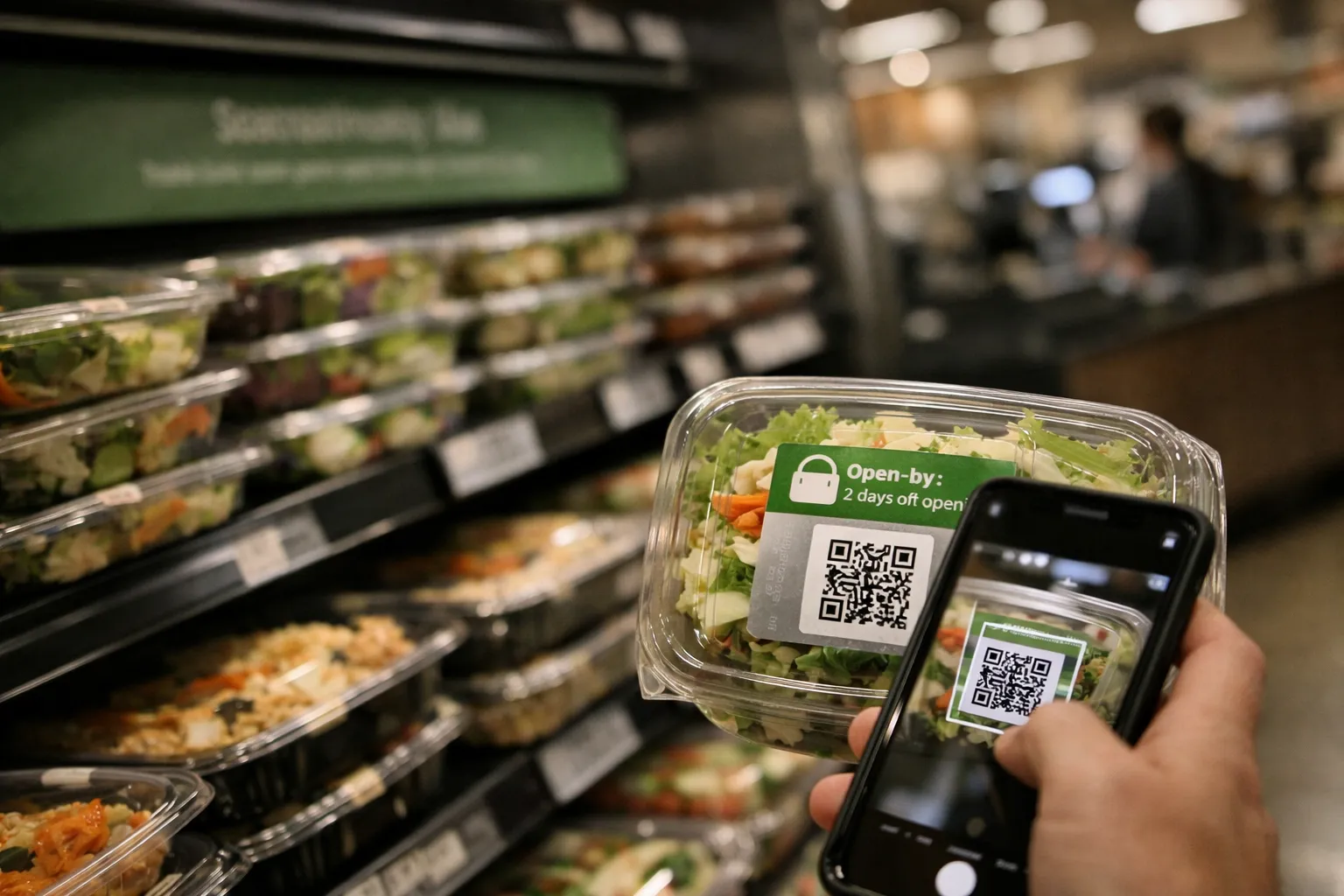
Who: a coalition of consumer‑packaged‑goods companies, eight major grocery retailers, packaging suppliers and digital‑label providers convened to pilot an on‑pack “open‑by” icon plus QR‑linked, dynamic shelf‑life guidance.
What: an interim August 2026 update on the pilot that tests whether a standardized "open‑by" icon plus short, mobile guides reduce household food waste without increasing food‑safety risk.
When: pilot launched March 2026; coalition released an interim summary and preliminary data on August 4, 2026. Full evaluation and methodology remain scheduled for a public report in late 2026.
Where: 80 pilot stores across urban and suburban markets in the United States, covering roughly 150 perishable SKUs (pre‑washed salads, deli prepared items, spreads and select yogurts) selected to reflect diverse household sizes and refrigeration access.
Why this matters: household food waste still accounts for a large share of avoidable food loss. Clear, consistent on‑pack cues could help shoppers avoid discarding edible food while maintaining safety. This update summarizes new data, expert reaction and concrete steps home cooks can use immediately.
Context: what led to this pilot and what’s different now
Governments and NGOs have pushed for clearer date and storage information for years. The U.S. interagency goal to halve food waste by 2030 (USDA/EPA, 2015) and UNEP’s Food Waste Index Report (2021) remain touchstones that show household behavior is a major leverage point for waste reduction. Confusion between quality‑focused labels (e.g., "best before") and safety‑focused guidance (e.g., "use by") has been repeatedly cited as driving premature discarding.
The coalition’s approach—an on‑pack “open‑by” icon that recommends a window for peak quality after opening plus a QR code linking to product‑specific, mobile‑formatted guidance—was designed to address both clarity and flexibility. Since March, the pilot has added printed secondary text on about two‑thirds of SKUs to serve shoppers without smartphones, responding to early equity concerns.
What the August 2026 interim data show
In its August 4 interim summary, the coalition reported the following preliminary findings from March–July 2026 activity and volunteer household monitoring:
- Modest reductions in avoidable waste: Volunteer households using "smart bins" and self‑reporting (n ≈ 820 households) reduced measured avoidable food waste by about 11% versus their pre‑pilot baseline. The coalition described this as an early signal, not a final result.
- QR engagement is real but selective: Average QR scan rates across pilot SKUs were 14–18% at point of purchase or opening; when QR landing pages were short (one‑screen storage tips and two "use soon" recipe ideas), engagement and next‑day use actions rose by ~40% compared with long manufacturer pages, coalition data show.
- In‑store awareness increased: Customer recall of the icon's meaning in intercept surveys rose from 12% pre‑pilot to 48% in stores with shelf signage and printed on‑pack text.
Coalition spokesperson Julie Martin, vice president for sustainability at one participating retailer, said in a statement: "Early data show that simple, science‑backed cues plus concise mobile content can change day‑to‑day behavior. The next step is publishing our validation methods so regulators and independent reviewers can assess safety assumptions."
Evidence, safety guardrails and expert perspectives
Public‑health guidance still frames safety decisions. CDC and FDA recommend refrigeration at or below 40°F (4°C) for chilled perishables and advise discarding perishable foods left above that temperature for more than two hours. The coalition's open‑by statements explicitly tie recommendations to a refrigeration assumption—e.g., "open‑by: 3 days after opening if kept at ≤4°C"—on many SKUs.
Food‑safety experts and consumer advocates have welcomed the pilot’s transparency but urged caution. At a July 2026 stakeholder workshop, consumer groups pressed for clearer printed options and larger type for visually impaired customers; food‑safety scientists emphasized the need to publish challenge‑study or shelf‑life testing data that undergird any safety‑adjacent claims. The coalition has committed to releasing its validation approach in the late‑2026 report.
What this means for home cooks—practical, evidence‑based steps
- Keep your fridge at ≤4°C (≤40°F): A fridge thermometer is inexpensive and is the single most important tool to align with label assumptions. Check temperature daily when possible.
- Label opened items with date and expected "use‑by" window: Mirror the packaging icon—write the open date and the recommended open‑by day. That reduces guesswork and conflict in shared households.
- Scan QR codes, but expect short content: The pilot shows shoppers are most likely to act when QR links provide a one‑screen storage note and two quick recipes. If a QR lands on a long page, search the page for "storage" or "ready to use" sections.
- Follow time‑temperature rules: Regardless of labels, discard perishable foods left at room temperature longer than two hours (one hour above 90°F/32°C). Vulnerable household members merit more conservative handling.
- Use freezing strategically: If you won’t use an opened item within the recommended window, freezing—when appropriate for the product—safely extends usability. Consult USDA FoodKeeper for product‑specific guidance.
Impact, reactions and equity concerns
Retailers see potential for waste reductions at scale, but independent verification remains critical. Consumer groups welcomed the interim reductions but stressed pilots must ensure underserved shoppers are not left behind; two‑thirds of pilot SKUs now include printed secondary text and stores with higher rates of smartphone nonuse tested additional shelf signage and staff training.
Food‑safety regulators have not changed national rules; rather, the pilot has prompted conversations. The coalition says it will invite FDA, USDA and consumer‑advocacy observers to review its final methods and data in late 2026.
What to watch next
- Late 2026: coalition’s full public evaluation and published validation methodology.
- 2027: possible phased rollout if independent reviewers and regulators find no increased food‑safety risk and measurable waste reductions persist.
- Ongoing: independent academic groups and consumer organizations requesting access to pilot data for verification; look for peer‑reviewed analyses in 2027.
Practical takeaways for August 2026
- Adopt pilot‑style habits now: use a fridge thermometer, write open dates, prioritize perishable ingredients and consult the USDA FoodKeeper for specifics.
- When a QR code is present, scan it—short, actionable content is more likely to change behavior.
- For young children, older adults, pregnant people and immunocompromised household members, err on the side of caution: when in doubt, discard.
FAQ
Does “open‑by” mean a product is unsafe after that window?
No. The coalition’s intended meaning is a recommended window for peak quality or recommended use after opening under specified refrigeration conditions (usually ≤4°C). Safety depends on time‑temperature history; follow CDC/FDA guidance—if a perishable spent more than two hours above 40°F (4°C), discard it regardless of labeled dates.
What if I don’t have a smartphone to scan QR codes?
Pilots now include printed secondary text on many SKUs and shelf signage in stores with higher rates of non‑smartphone shoppers. Meanwhile, use paper storage charts (USDA FoodKeeper pamphlet), label open dates, and follow conservative timelines.
How will regulators verify the “open‑by” timeframes?
Regulators expect traceable evidence such as accelerated shelf‑life testing, challenge studies or validated manufacturer data when a label implies storage or safety guidance. The coalition has committed to publishing its validation methodology with the late‑2026 report so regulators and independent reviewers can assess it.
Can “open‑by” labeling help me save money?
Potentially. The pilot’s early household data suggest modest reductions in avoidable waste (~11% in volunteer households). For individual shoppers, using date cues plus basic storage practices (fridge thermometer, labeling, freezing) is the most reliable way to cut waste and keep food safe.
Disclosure: I am Dr. Emily Torres, Health & Wellness Correspondent. This article summarizes public pilot activity, interim coalition data and established food‑safety guidance to help home cooks reduce waste safely. It is not a substitute for professional advice—when food safety is in doubt, follow official guidance or contact your local health authority.