
What you'll learn: How to make reliably crunchy refrigerator quick pickles in a repeatable 72‑hour framework, using modern tools and 2026 best practices. This guide is for food enthusiasts who want consistent texture (the satisfying snap), contemporary flavor profiles (low-sugar, global spices), and safety-aligned technique you can reproduce jar after jar.
Prerequisites / Context: quick pickles vs. fermented vs. canned
Clarify what you intend to make. This guide covers refrigerator quick pickles only: a vinegar-based brine, chilled storage, and no water‑bath processing. It is not a fermentation method and not a shelf‑stable canning procedure.
- Refrigerator quick pickles (this method): Vinegar-based brine; jars stored at ≤40°F (4°C). Fast—hours to days—and designed for immediate tang and snap.
- Lacto-fermented pickles: Salt brine, room-temperature fermentation, then cold storage. Slower development (days–weeks) and a different flavor/texture profile; microbes create the acid.
- Water‑bath canned pickles: Vinegar brine processed to create shelf-stable jars. Only use validated USDA or land-grant extension recipes for safety.
Safety baseline: Follow tested acidity and refrigeration practices. For authoritative canning guidance, consult the USDA Complete Guide to Home Canning or your state cooperative extension (Cornell, UC Davis, Penn State, etc.).
What’s new (Aug 2026) and why it matters
Since the original update in May 2026 several practical trends matured and are now common in both pro and home kitchens:
- Weight-based brining is standard practice. Affordable kitchen scales and recipe sharing have normalized grams-based brines; this eliminates the inconsistency that comes from variable salt crystal sizes.
- Vacuum-assisted infusion is widely adopted. Compact jar pumps and jar-sealer attachments (the same vacuum technology used for food storage) are used at home to draw brine into vegetable tissues, reliably reducing the time to ready pickles without changing brine chemistry.
- Flavor experimentation with low-sugar brines has become a default. Home cooks in 2026 are pairing lower sugar with brighter aromatics (citrus peel, ginger, herbs) and stronger spice blends—this demands attention to balance but not to food safety if acidity is correct.
- Test-kitchen experience emphasizes texture over tricks. Practical steps—trim blossom ends, cut thicker where needed, and cold‑shock—deliver predictable snap more often than novelty additives alone.
What you’ll need
- Vegetables: small cucumbers (Persian, Kirby), baby carrots, radishes, green beans, cauliflower florets, daikon, sliced fennel or red onion.
- Vinegar (5% acidity): distilled white, apple cider, or unseasoned rice vinegar.
- Salt: pickling/canning salt or kosher (weigh it).
- Sugar (optional): white, light brown, or erythritol/xylitol for low-sugar preferences.
- Flavorings: dill, garlic, mustard seed, coriander, peppercorns, bay, fresh ginger, citrus peel, gochugaru, or ras el hanout for global profiles.
- Calcium chloride (optional): sold as Pickle Crisp—effective and flavor-neutral when dosed per manufacturer directions.
- Clean jars and lids: pint/quart Mason jars or non-reactive containers.
- Scale: inexpensive digital kitchen scale (grams).
- Optional tools: vacuum jar pump or vacuum sealer jar attachment, small glass jar weights, ice bath container, thermometer.
Step 1: Choose vegetables that stay crisp—and prep them correctly
- Select firm, younger produce. For the best snap, choose small, dense cucumbers (Kirby or Persian), young carrots, and firm radishes. Avoid produce with soft spots or pitting; those cells will collapse in acid.
- Cut to preserve structure. Thicker cuts retain crunch—¼–½ inch spears or chips for cucumbers, whole small carrots, halved radishes. Reserve thin ribbons for same‑day garnish; they soften quickly.
- Trim the blossom end of cucumbers. Trim a very thin slice from the blossom end (opposite the stem). University extension guidance and test kitchens continue to note enzymes there speed softening.
- Cold-holding before brining. Chill prepared vegetables 30–60 minutes or soak cucumbers in ice water for 20–30 minutes. Cold tissues tolerate warm brine better and hold structure.
Example: For a deli-style pint: 450 g small Persian cucumbers cut into spears, 3 lightly crushed garlic cloves, 2 small dill sprigs, 1 tsp mustard seed.
Step 2: Use a brine ratio that’s repeatable
Volume measures are serviceable; weight-based formulas are reliably consistent across kitchens.
Common quick-pickle brine (by volume):
- 1 cup (240 ml) 5% vinegar
- 1 cup (240 ml) water
- 1 tablespoon kosher salt (or 2 tsp fine pickling salt)
- 1–2 tablespoons sugar (optional)
Recommended: brine by weight (best reproducibility):
- 1000 g total liquid (500 g vinegar + 500 g water)
- 20–25 g salt (2.0–2.5% of liquid by weight)
- 10–30 g sugar depending on preference
Why weight matters: Kosher and pickling salts vary widely in volume per gram. Weighing removes that variable so your jars taste the same next month as they do today.
Step 3: Hot brine, cold brine, and the useful compromise
- Hot brine (speed):
- Warm the brine just to dissolve salt and sugar—simmer briefly, not a rolling boil.
- Pour over thoroughly chilled vegetables to minimize thermal softening.
- Why: Heat extracts spice oils quickly and shortens the time to ready pickles.
- Cold brine (maximum crunch):
- Stir to dissolve salt; cool completely before pouring.
- Why: Limits heat-induced cell damage; flavor takes longer to develop.
Practical middle path: Use a warm (not hot) brine poured over ice-chilled vegetables, then set the jars briefly in an ice bath to lock tissues. This balances speed and texture and is now the most common approach in home test kitchens.
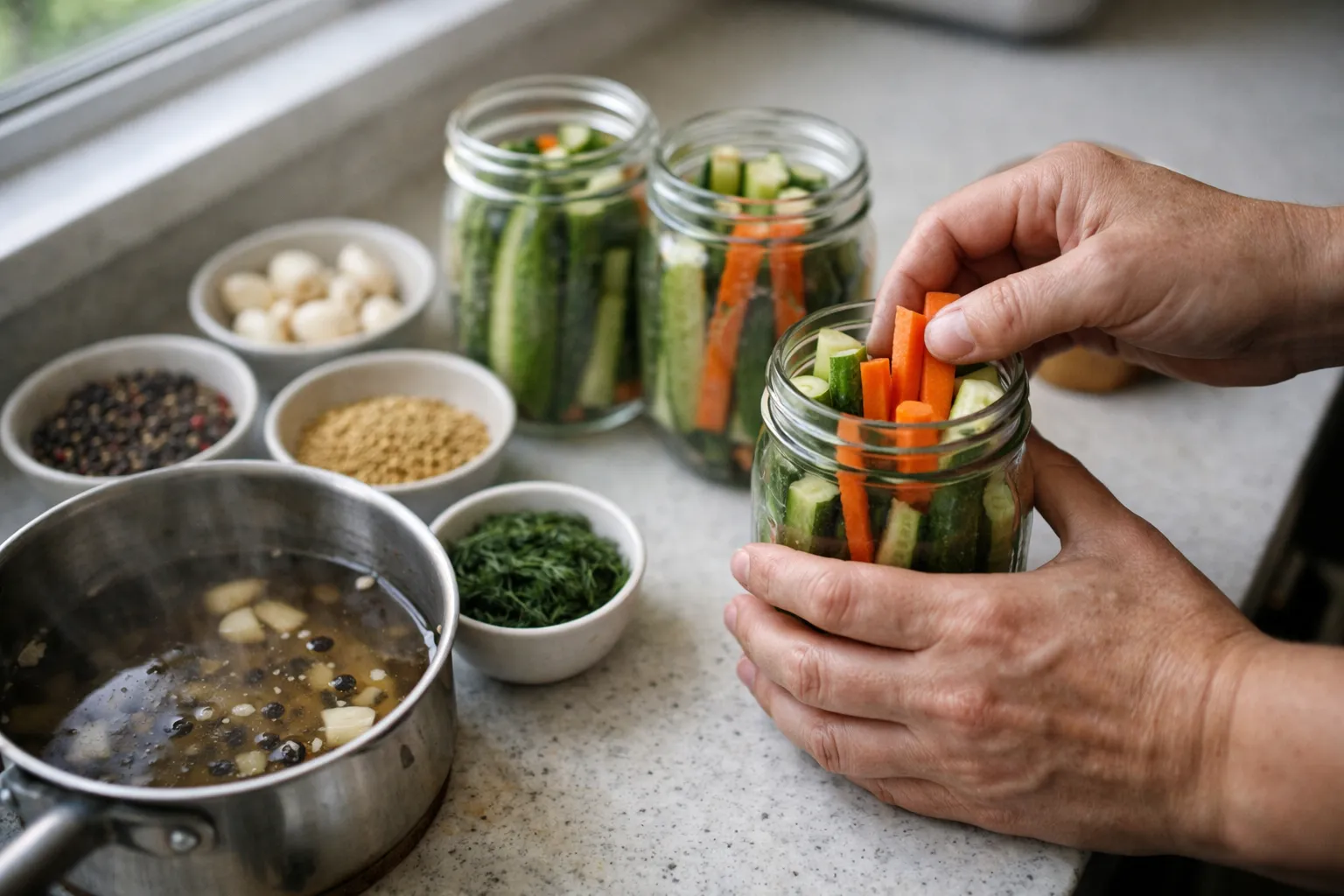
Step 4: Pack jars to maximize contact and prevent floating
- Clean jars—sterilization not required for refrigerator pickles but do wash lids and jars thoroughly to reduce spoilage risk.
- Layer aromatics: Place whole spices and aromatics at the bottom to allow upward infusion.
- Pack tightly: Compact packing reduces floating and helps even pickling.
- Keep fully covered: Cover with brine, leaving ~½ inch headspace. If items float, use a small glass weight, a cabbage leaf, or repack snugly.
Example packing (pint): cucumber spears, 1 smashed garlic clove, ½ tsp mustard seed, ½ tsp coriander seed, 6 peppercorns, 1 small dill sprig.
Step 5: Use vacuum infusion when you need speed (and how to do it safely)
Vacuum-assisted infusion is now a practical, accessible acceleration method for pickles. A handheld jar pump or a vacuum sealer jar attachment removes trapped air and draws brine more quickly into vegetable tissues, often shortening the time to ready pickles from 48–72 hours to 12–24 hours.
- Use correct brine chemistry first: Vacuuming is a time-saver — it does not change required vinegar or salt levels. Always make the brine to correct acidity and salinity as described above.
- Pack and pour: Pack the jar with fully chilled vegetables, pour brine to cover, then attach the vacuum device according to manufacturer instructions.
- Vacuum in short cycles: Apply vacuum for short bursts, then release; repeat 2–3 times to avoid tissue damage. Many home pumps have built-in cycles—follow the tool’s guidance.
- Chill immediately: After vacuuming, refrigerate without delay.
Note: Vacuuming can increase brine penetration but does not sterilize. Follow clean handling and refrigeration rules. For specific jar attachments, use the manufacturer’s instructions for safe use.
Step 6: Refrigerate and respect the 72‑hour crunch window
Flavor and texture evolve quickly:
- 4–6 hours: Lightly seasoned; still very fresh.
- 24 hours: Good flavor and often excellent crunch—many jars are ready to eat.
- 48–72 hours: Spices and acid are well distributed; most jars reach their ideal eating balance.
- Cool before sealing if you used hot brine. Let jars come to near-room temperature, then refrigerate promptly.
- Label jars: Date, basic salt weight, and dominant flavor—this makes replication effortless.
- Best window: Peak crunch and flavor usually occur between 3–14 days. Refrigerated jars remain safe longer if handled cleanly, but texture will soften over time.
Food-safety habits: Use clean utensils, keep jars refrigerated at ≤40°F (4°C), and discard any jar with mold, off‑odors, or persistent fizzing (sign of unwanted fermentation).
Crunch-boosters that actually work
- Calcium chloride (Pickle Crisp): Firms pectin without altering flavor; use manufacturer dosage. Preferred over traditional alum (which is not recommended).
- Dry-salting pre-treatment: Toss slices with 1–2% salt by weight, rest 30–60 minutes, then drain—this concentrates cell walls and improves snap.
- Cold shock: After pouring warm brine, submerge jars briefly in an ice bath to set tissues.
- Vacuum-assisted infusion: Practical for speed; it works best when combined with cold-prepared vegetables and correct brine.
Common mistakes—and precise fixes
- Mistake: Using seasoned vinegars unknowingly.
Fix: Use unseasoned vinegar or taste and adjust sugar/salt before pouring. - Mistake: Measuring salt by volume across brands.
Fix: Weigh salt for consistency; aim for 2.0–2.5% of total liquid weight. - Mistake: Slicing too thin.
Fix: Cut thicker chips/spears; reserve thin slices for same-day use. - Mistake: Vegetables floating and oxidizing.
Fix: Repack tighter, top up brine, or use a weight to keep everything submerged. - Mistake: Treating refrigerator pickles as shelf-stable.
Fix: Keep refrigerated. For shelf stability, follow validated water‑bath canning procedures from USDA or your extension service.
Pro tips for flavor and value
- Layer deliberately: Use one backbone spice (mustard or coriander), one aromatic (dill, ginger, citrus peel), and one heat note (fresh chiles or gochugaru). This balanced approach reads as complex even with modest sugar.
- Match vinegar to vegetable: Distilled white for classic snap; apple cider for roots; rice vinegar for lighter Asian profiles. Two-vinegar blends (half white, half apple cider) are an elegant compromise.
- Manage garlic intensity: Raw garlic intensifies over time; for subtler garlic, blanch cloves 30 seconds or use smashed but fewer pieces.
- Think about reuse thoughtfully: Reheating used brine to a boil and reducing it before reuse is a way to repurpose brine, but for best flavor and hygiene make fresh brine when possible.
- Label with data: Note salt grams and vinegar proportions on the jar—this is the single best step for repeatability and evolving your technique.
Why this matters
In 2026 home cooks want predictability as much as creativity. The luxury of a crisp, bright pickle—one that offsets rich mains, refreshes salads, and lasts a week in the fridge—depends on small, testable steps: accurate salt, correct acidity, controlled temperature, and smart packing. Those are the differences between a jar that snaps and one that sags.
Common-sense safety and reference points
Maintain proper acidity (5% vinegar standard), keep jars refrigerated at ≤40°F (4°C), and follow validated procedures for shelf-stable canning. For authoritative guidance, consult USDA resources and your state cooperative extension (Cornell, UC Davis, Penn State, University of Georgia, etc.). Follow manufacturer instructions for any additives (calcium chloride) exactly.
FAQ
Can I speed up pickling safely with a vacuum pump?
Yes. Vacuum jar pumps and jar-sealer attachments for countertop sealers can accelerate brine penetration by removing trapped air and drawing brine into vegetable tissues. Use vacuuming as a time-saver only—do not reduce vinegar or salt levels because of vacuuming. Refrigerate promptly and use clean utensils.
How much calcium chloride should I use?
Follow the manufacturer’s package directions for the specific product you buy (commonly sold as Pickle Crisp). Typical doses are small (a fraction of a teaspoon per pint) and designed to firm pectin without affecting flavor when used as directed.
Are low- or no-sugar quick pickles safe and tasty?
Yes. Sugar is a flavor-balancing ingredient in quick pickles, not a preservative in a vinegar brine stored under refrigeration. Reduce or omit sugar to taste and use aromatics (citrus, ginger, warm spices) to compensate for perceived sweetness. Always maintain correct vinegar proportion and refrigeration.
Why did my brine go cloudy?
Cloudiness is often from spice sediment, garlic proteins, or mineral content in the water and is not automatically unsafe for refrigerator pickles. If you see mold, detect off-odors, or notice persistent fizzing—discard the jar. For a clearer brine, use filtered water and non-iodized salt.
How long will refrigerator quick pickles last?
Peak eating quality for crunch is typically between 3–14 days. Jars kept at ≤40°F (4°C) and handled cleanly can remain safe longer, but texture and flavor will continue to evolve. Discard any jar with unusual smells, visible mold, or slime.
For home cooks who prize texture and reproducibility, the smallest investments—an inexpensive scale, careful trimming, and a patient 48–72 hour window—deliver the most consistent results. Use vacuum or other modern tools as accelerants, not substitutes, and you’ll have crisp, balanced pickles every time.