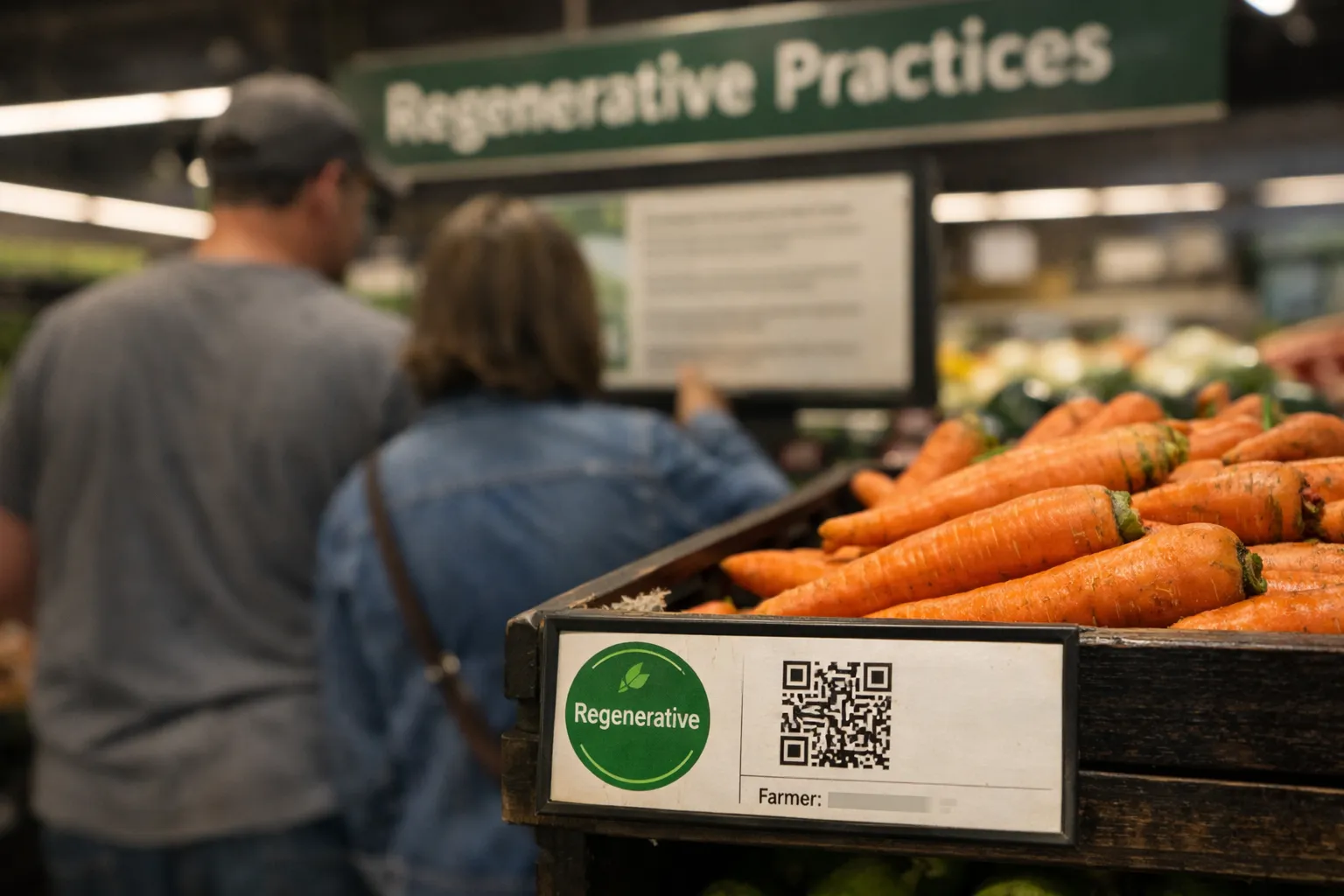
Who: U.S. supermarket chains, produce suppliers, farm-data platforms, agricultural NGOs and federal agencies.
What: Widening use of on-shelf “regenerative” badges, expanded QR-linked traceability, more common third‑party audits and emerging standard scorecards intended to reduce consumer confusion.
When: Update as of November 2026 (original reporting began in late 2025; prior update was June 2026).
Where: National and influential regional grocery chains across the United States, with pilots and seasonal rollouts concentrated in major produce-sourcing regions (California, Florida, Pacific Northwest, Upper Midwest).
Why this matters: Regenerative labels attempt to connect shoppers to farm stewardship—soil health, carbon management and reduced synthetic inputs—but credibility, farmer economics and standardized verification remain the sector’s immediate tests. Shoppers, chefs and growers need clear signals now that distinguish substantive programs from marketing language.
Context: from the 2025 USDA pilot to broader scaling in 2026
The USDA’s 2025 verification pilot and a string of retailer pilots in late 2025 and early 2026 spurred an acceleration of programs through mid‑2026. Between June and November 2026 the most visible change has been scale: several large chains moved from single-store tests to regional or national assortments for selected items (seasonal berries, apples, leafy greens and selected herbs). Retailers say this shift responds to continued consumer interest in environmental sourcing and to supplier requests for clearer procurement pathways that reward conservation practices.
What retailers and grocers are testing now (Nov 2026)
Pilots that looked experimental in early 2026 now show repeatable design patterns:
- Tiered labeling: More retailers deploy short on-shelf badges for quick recognition plus a “learn more” QR that links to layered evidence—practice logs, audited summaries and farm media.
- Outcome data alongside practice claims: Where feasible, labels now combine practice disclosure (cover crops, reduced tillage, extended rotations) with outcome indicators such as measured soil organic carbon changes or reduced nitrogen inputs over a multi‑year window.
- Digital-first experiments continue: E-commerce listings let chains A/B-test messaging and price points without costly shelf-label runs—useful when retailers trial small premiums or loyalty discounts.
- Curated promotions: Retailers are testing “regenerative weeks” with in-store demos and chef tie-ins to measure whether stewardship stories lift basket sizes or increase trial among mainstream shoppers.
Verification: what’s changed by November 2026
Verification remains the sector’s crux, but six practical changes are clear:
- Standard scorecards are emerging: Retailer‑NGO working groups have converged on common minimum evidence packages—two seasons of field logs plus either a third‑party audit or documented remote‑sensing corroboration—reducing duplication for growers who sell to multiple chains.
- Soil testing is being added selectively: Some programs now require baseline and periodic laboratory soil organic carbon (SOC) sampling for multi‑year contracts, particularly for items where supply comes from large, consolidated operations that can absorb sampling costs.
- Remote sensing is operationalized: Satellite NDVI time series and drone imagery are now routine corroboration tools; farm-data platforms provide dashboards that sync field records with imagery timelines for auditors.
- Group audits scale for small farms: Cooperative audits and auditor “stinting” models lower per‑farm costs and preserve traceability while enabling smallholders to participate without prohibitive fees.
- Immutable records used selectively: A handful of pilots are using distributed ledgers to timestamp records; most programs still consider simple, auditable cloud records sufficient if they are paired with robust audits and imagery.
- FTC scrutiny persists: Retailers report legal reviews to avoid broad environmental claims without supporting evidence; consumer advocates continue to press for plain‑language disclosures linked to audit summaries.
Economics: premiums, costs and what growers report
Price signals have become clearer but modest. Across a representative set of retail pilots through November 2026, regenerative-labeled produce typically carried retail premiums in the low single digits to low double digits (roughly 3–12%). Those premiums have compressed in some categories as programs scale and as retailers use loyalty offers and promotional windows to reduce the price gap.
For growers, three factors determine participation:
- Verification cost-sharing: USDA conservation cost-share programs, state grants and retailer co‑funding remain decisive; growers without access to these supports struggle to justify auditing and soil testing costs.
- Longer-term contracts: Multi-year sourcing commitments or preferred‑supplier status are cited by growers as the most valuable non‑premium benefit—security that helps amortize on‑farm investments in cover cropping and equipment.
- Administrative burden: Farm-data platforms and cooperative templates have reduced per‑farm recordkeeping time in scaled programs, though small diversified farms still report higher relative effort than large mono‑crop operations.
What this means for shoppers, chefs and home cooks
Practical implications for November 2026:
- Look for evidence, not buzzwords: Credible labels link to audit summaries, named third‑party auditors or cooperative verification and—when provided—soil testing results or remote‑sensing time series.
- Expect modest premiums and promotional cycles: Regenerative items typically cost more, but retailers often run promotions or apply loyalty discounts; watch for “regenerative weeks.”
- Taste and shelf life are not guaranteed: As before, stewardship claims signal practices, not sensory attributes; variety, harvest timing and cold chain determine flavor and freshness.
Chefs and food professionals increasingly use regenerative sourcing as part of menu storytelling, but many continue to request direct supplier conversations to verify claims before promoting them to diners.
Industry reactions and policy watch
Retailers, farm‑data vendors and NGOs have sharpened their positions. Vendor consolidation is visible: several established ag‑tech platforms now offer turnkey stacks combining recordkeeping, imagery analysis and auditor interfaces. Meanwhile, consumer advocates and the Federal Trade Commission retain oversight interest; legal teams and trade groups are actively crafting plain‑language disclosure templates to reduce risk of deceptive green claims.
What to watch next
- Standard adoption: Whether a common, widely accepted scorecard gains broad retailer and NGO buy‑in in early 2027.
- Soil‑outcome measurement: Expansion of lab‑based SOC sampling or validated proxies tied to multi‑year contracts.
- Retail scaling: If more national chains convert pilots into permanent assortments and incorporate regenerative criteria into supplier scorecards.
- Consumer behavior data: Look for national market‑research releases in late 2026 and early 2027 to clarify willingness‑to‑pay trends and repeat purchase behaviour.
Bottom line
As of November 2026, regenerative produce labels have advanced from scattered experiments to repeatable retail program designs that emphasize layered evidence: practice logs, third‑party audits and remote sensing or selective soil sampling. The labels offer a clearer stewardship story than a year ago, but they remain heterogeneous in scope and rigor. For shoppers: prioritize labels that link to named auditors or clear evidence, expect modest premiums, and treat the label as a stewardship and sourcing story—not a guaranteed marker of superior taste or shelf life.
How do I know a regenerative label is credible?
Look for a short on-shelf explanation plus a QR that links to at least two of these: an audit summary from a named third‑party auditor, multi‑year farm practice records, remote‑sensing timelines (NDVI) or laboratory soil test results. Absence of documentary links or vague language like “supports soil health” without evidence is a red flag.
Will regenerative produce taste different or last longer?
Not reliably. Regenerative practices relate to stewardship and ecosystem outcomes; flavor and shelf life depend primarily on variety, harvest timing and cold chain handling. Some producers who emphasize stewardship also prioritize quality‑focused harvest and handling, which can indirectly improve eating quality.
Are premiums paid to growers transparent?
Transparency varies. Many pilots involve modest retailer premiums or non‑price benefits such as multi‑year contracts. If you want to know whether premiums reach farmers, look for retailer disclosures or supplier statements that specify how premiums or sourcing commitments are allocated.
Can small farms participate without heavy costs?
Yes—if they join cooperative audit models, use group certifications, access USDA or state cost‑share programs, or adopt standardized farm‑data templates. These approaches reduce per‑farm fees and administrative time, though some upfront work is still required.