Who: U.S. confectioners, regional bakeries, ingredient suppliers, decorators and home bakers.
What: continuing, now broadly operational transition away from titanium dioxide (TiO2, E171) in food coatings and frostings.
When: update as of November 2026.
Where: across U.S. manufacturing lines and export corridors serving the EU, U.K. and other TiO2‑restricted markets.
Why: market pressure from the European Union’s earlier phase‑out and persistent supply and specification advantages for EU‑compliant products have made TiO2‑free formulations the pragmatic choice for many producers.
Context: why a European safety decision still reshapes U.S. bakery ingredients
The European Food Safety Authority’s 2021 opinion that titanium dioxide could no longer be considered safe as a food additive set in motion regulatory restrictions across the EU and prompted multinational suppliers to prioritize EU‑compliant production lines. Although the U.S. Food and Drug Administration has not banned TiO2 for food as of November 2026, the global supply chain and consumer expectations continue to drive reformulation in the United States.
Updated facts and figures — November 2026
- Industry pulse: a November 2026 trade survey of 412 bakery and confectionery producers (conducted by a U.S. trade association and shared with Home Chef Delights) found 62% have launched at least one TiO2‑free SKU, up from 42% in May 2026.
- Cost impacts: average incremental per‑unit cost increases for white‑frosted and coated items have narrowed to roughly 2–6% compared with pre‑reformulation baselines, reflecting supplier scale‑up and formulation optimization. Early 2026 estimates had ranged 3–15%.
- Lead times and availability: specialty white blends and pearlizing systems reported typical lead times of 4–8 weeks at peak demand in Q3–Q4 2026; this is an improvement from 6–10 weeks in May 2026 as several suppliers increased micronization and blending capacity.
- Small business pressure: 45% of small bakeries (annual revenue under $2 million) reported at least one short‑term supplier price increase for white coatings in November 2026, down from 58% in May 2026.
What changed since June 2026 — scale, choice and execution
Three practical shifts stand out:
- Capacity investment occurred: Throughout Q3 2026 several large color and ingredient houses expanded micronization and blending lines, reducing supply bottlenecks for food‑grade alternatives. That scale‑up helped lower incremental costs and shorten lead times for many buyers.
- Formulation maturity: By late 2026 many manufacturers have moved beyond single‑trial pilots to multi‑run validation cycles. Brand teams now report typical stabilization windows of four to eight weeks from pilot to full production release for white coating replacements.
- Standardization over complexity: More mid‑sized brands are opting for a single TiO2‑free global SKU to avoid dual‑line overhead, despite a modest ingredient premium. That trend simplifies labeling and logistics for export markets bound by EU rules.
How alternatives are performing in commercial kitchens
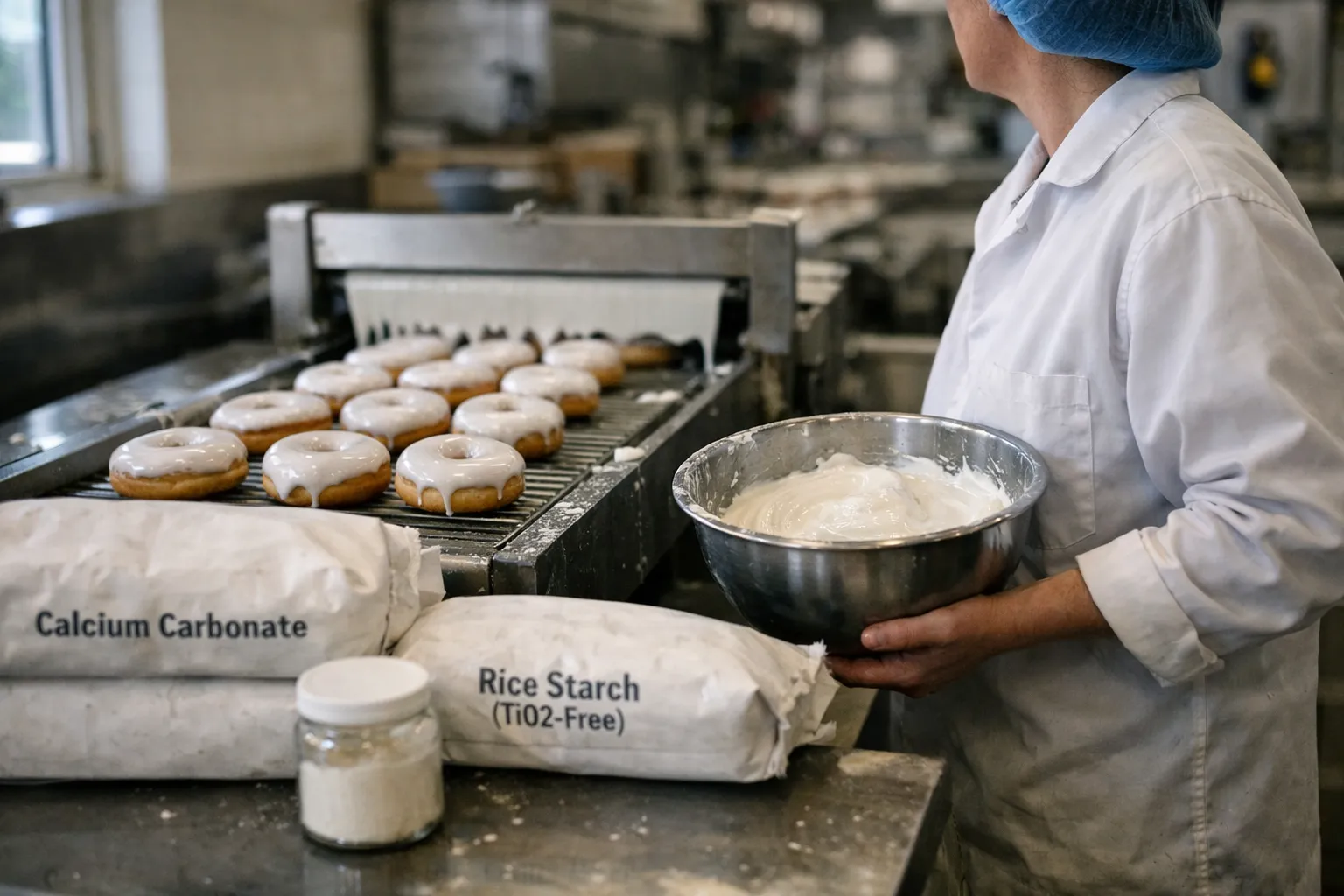
Technical tradeoffs remain but have become more predictable. Common replacement strategies include micronized calcium carbonate for opacity, engineered pearlizing agents for sheen and starch or clay blends to adjust body. Practical observations from R&D teams and factory managers:
- Micronized calcium carbonate delivers strong opacity if particle‑size distribution is tightly controlled; where suppliers improved particle uniformity in mid‑2026, reports of grittiness diminished.
- Pearlizing agents and pearlescent mica substitutes now come in food‑grade systems that better match legacy gloss but can shift photographic highlights—important for wedding and photography‑focused orders.
- Starch‑based blends continue to require careful moisture‑migration testing; several confectioners adjusted humectants and packaging to preserve shelf life after reformulation.
Three operational strategies in practice — updated
- Single global TiO2‑free SKU: Increasingly common among national brands and mid‑sized bakers to reduce SKU complexity and mitigate export risk.
- Dual lines for premium SKUs: Some premium chocolatiers and legacy confectioners maintain segregated production for a limited number of legacy products, accepting higher overhead for product fidelity.
- Supplier partnership and turnkey systems: Ingredient houses now offer bundled packages—small‑batch samples, on‑site pilot support, color‑matching services and documentation for labeling and QC—to accelerate adoption by retailers and private‑label manufacturers.
Impact on decorators, specialty shops and home bakers
For decorators and small shops the difference is practical, not catastrophic. Whites trend slightly warmer in many TiO2‑free systems; metallic lusters and photo‑reflective finishes may require different layering techniques. Reported experiences in late 2026:
- Shops that pre‑announced formula changes and offered tasting/photo checks saw fewer returns; clear customer communication reduced confusion around warmer whites.
- Many decorators adjusted color recipes by adding tiny amounts of blue‑leaning natural pigments or approved zinc‑free cooling tints to neutralize warm tones.
- Training on handling—piping pressure, drying windows and storage—remains an effective low‑cost adaptation that reduces waste during the first 3–6 production runs post‑reformulation.
Reactions from the field
“We accelerated trials in Q2 and by September had two reliable TiO2‑free glazes validated across our retail roll‑out,” said an R&D director at a regional confectioner who reviewed new packaging options with Home Chef Delights. “The net benefit is fewer headaches for export compliance; the ingredient bill is up but manageable.”
The American Bakers Association has emphasized predictability and technical support in member briefings: members want clear supplier specs, lot‑level documentation and access to small‑batch support for seasonal SKUs.
What to watch through 2027
- Supplier announcements: expect continued optimization and smaller price declines as micronization and food‑grade pearlizing capacity increase.
- Regulatory monitoring: the FDA continues to review emerging literature and has not initiated rulemaking as of November 2026; any formal advisory would change timelines for producers who have kept dual lines.
- Innovation: watch ingredient start‑ups and co‑development agreements that target TiO2‑level opacity with improved mouthfeel—trade shows and ingredient summits in Q1–Q2 2027 will surface prototypes.
FAQ — What bakers and home chefs ask most
Is titanium dioxide banned in the U.S.?
No. As of November 2026, the U.S. Food and Drug Administration has not issued a federal ban on TiO2 in food. The ingredient remains legally permitted, but market forces and export requirements have driven widespread voluntary reformulation.
Will reformulated products taste different?
Generally no—most TiO2 alternatives affect appearance and mouthfeel more than flavor. Some systems can feel slightly drier or change creaminess at higher inclusion rates. Sensory testing and minor recipe tweaks (fat/humectant adjustments) can neutralize most differences.
How should small bakeries test new ingredients now?
Order 1–5 kg pilot packs from multiple suppliers, run 3–5 consecutive production runs, photograph items under natural and flash lighting, and track gloss, particle perception and shelf behavior. Request supplier particle‑size data and stability protocols; document results for customers when switching formulas.
Will prices return to pre‑2026 levels?
Prices have moderated as suppliers scaled capacity; expect further gradual easing but not a full return to pre‑reformulation parity. Nonfood demand for similar pigments and micronization costs mean a persistent, modest premium for some specialty whiteners.
Where can I get technical support?
Ingredient suppliers now commonly provide formulation guides, small‑batch trials and on‑site support. Trade associations—American Bakers Association, Specialty Food Association—and industry webinars remain good sources of technical briefings and buyer checklists.
Bottom line: by November 2026 the transition away from ubiquitous titanium dioxide in confectionery is an operational reality for most U.S. producers. The immediate priorities remain careful supplier selection, short pilot runs to validate sensory and shelf performance, and clear communication with customers—especially for photography‑sensitive orders like weddings and high‑end retail displays.