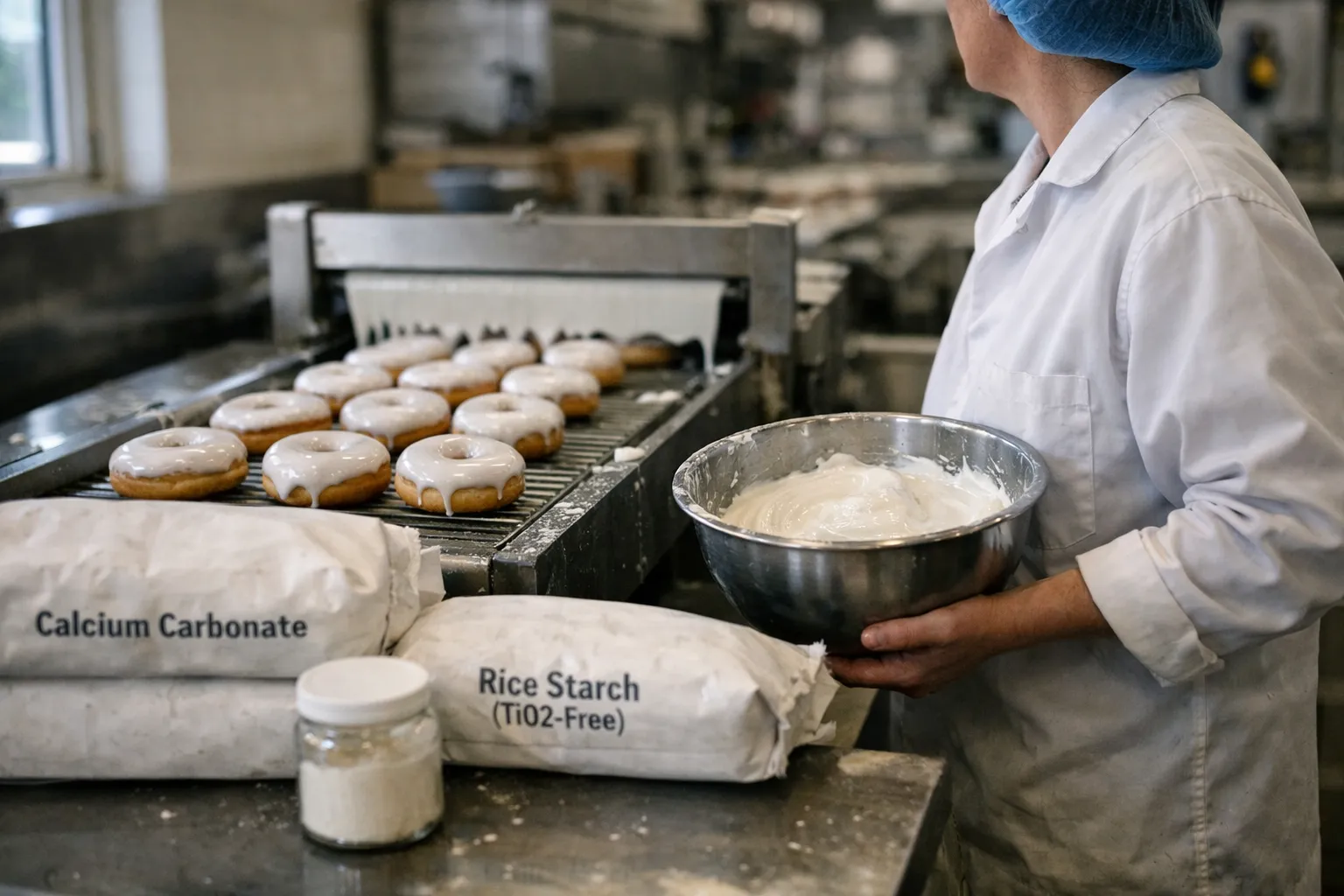
Who: U.S. confectioners, regional bakeries, ingredient suppliers and specialty decorators. What: an accelerated shift to titanium‑dioxide (TiO2, E171)‑free formulations. When: June 2026. Where: across the United States supply chain and export corridors. Why: the European Union’s phase‑out of TiO2 for food has tightened global pigment supply and driven manufacturers to adopt EU‑compliant recipes for cross‑border consistency.
Context: how a European action reshaped a global ingredient market
The European Food Safety Authority (EFSA) concluded in 2021 that titanium dioxide could no longer be considered safe as a food additive, prompting EU food‑market restrictions that took effect in the early 2020s. Although the U.S. Food and Drug Administration (FDA) has not imposed a domestic ban and continues to monitor the scientific record, the market effect has been global: multinational suppliers prioritized EU‑compliant production, shaving TiO2 volumes available for food uses sold into the United States.
Since the original March 2026 report, the trend hardened. Ingredient manufacturers expanded lines of alternative whiteners, distributors instituted allocation rules in April and May 2026, and a growing share of U.S. manufacturers have standardized on TiO2‑free formulas to simplify logistics and protect export channels.
Updated facts and figures — June 2026
- Industry survey data (American Bakers Association, May 2026, n=312) shows 42% of surveyed confectionery and bakery producers have launched at least one TiO2‑free SKU, up from 18% in December 2025.
- Average ingredient cost impacts have moderated as suppliers scale production: companies report incremental per‑unit cost increases averaging 3–10% for white‑frosted goods after reformulation, compared with 5–15% reported earlier in 2026.
- Major color and ingredient suppliers — including Sensient Technologies, Givaudan and Chr. Hansen — announced expanded alternative pigment portfolios in Q1–Q2 2026; distributors report lead times for specialty blends of 6–10 weeks at peak demand in May 2026.
Why TiO2 matters to bakers and candy makers — and what’s different now
Titanium dioxide delivered intense whiteness and opacity at low usage, with little impact on texture or flavor. Replacing it remains technically complex: alternatives such as micronized calcium carbonate, engineered pearlizing agents, food‑grade clays and starch blends change gloss, mouthfeel and shelf behavior.
What’s different in June 2026:
- Scale: larger production runs of alternatives have reduced some premium costs but raised raw‑material competition with nonfood uses (cosmetics, coatings).
- Validation pace: firms that adopted rapid reformulation in early 2026 are now reporting six‑ to eight‑week stabilization cycles for commercial launches versus multi‑month pilots earlier in the year.
- Product segmentation: an increasing number of mid‑size manufacturers are choosing a single global TiO2‑free formulation to eliminate dual‑line complexity, even when domestic TiO2 use remains permitted.
Industry responses: three strategies, updated
- Full reformulation (single global SKU): Many national brands and some regional bakery groups are standardizing on TiO2‑free recipes. The move simplifies compliance and logistics; it also reduces the risk of mislabeling when products cross borders.
- Dual manufacturing lines (selective): A smaller group of premium confectioners continues to operate segregated lines—TiO2 versions for U.S. domestic channels and TiO2‑free for export—accepting higher overheads for product fidelity on legacy SKUs.
- Supplier partnerships and white‑label solutions: Retailers and private‑label producers increasingly contract with ingredient houses for turnkey TiO2‑free coating systems. Suppliers now offer formulation support, sensory panels and scale‑up services as bundled offerings.
Costs, technical tradeoffs and what bakeries are experiencing
Across small and mid‑sized operations, reformulation costs still matter. The ABA’s May 2026 survey found that 58% of small bakeries (annual revenue under $2 million) reported at least one short‑term supplier price increase for white coatings. Consultants now report that careful micronization and dispersants can reduce grit and gloss issues, but require new ingredient specifications and supplier audits.
Practical technical tradeoffs reported in June 2026:
- Micronized calcium carbonate works for opacity but needs strict particle‑size control to avoid grittiness.
- Pearlizing agents recreate sheen but may shift a matte finish toward gloss, affecting photography and display expectations.
- Starch‑based blends can alter moisture migration, changing shelf life and freeze/thaw stability in some filled confections.
Impact on decorators, specialty shops and home bakers
Professional decorators and specialty cake shops continue to see practical differences: whites trend slightly warmer, metallic lusters sit differently, and fewer ready‑to‑use white candy coatings are identical to legacy products. Retailers reporting reformulated private‑label fondants note higher initial returns for wedding cakes during the first month of a formula change; sales stabilized after targeted color‑matching and customer communication.
Recommended short‑term actions for decorators and small shops (updated June 2026):
- Source small test quantities from multiple suppliers and record batch performance across 3–5 production runs.
- Adjust color recipes: use a touch of titanium‑free “cooling” pigments (ultra‑fine zinc oxide alternatives or blue‑leaning natural pigments) to neutralize warm whites.
- Train staff in new handling: different gloss and flow mean changes to piping tips, tempering and drying windows.
- Label and communicate: describe products as “TiO2‑free” and include short notes on expected visual differences for key customers (weddings, photoshoots).
Reactions from the field
“We planned for this six months ago and sped up trials in March. By May we had two new white coating systems validated and in production,” said a senior R&D manager at a national confectioner who requested anonymity to avoid supplier sensitivity. “The biggest win has been consolidation with one global formula—administratively simpler, though the ingredient bill is still higher than with TiO2.”
The American Bakers Association noted in a May 2026 briefing that the priority for members is supply predictability: “Manufacturers need stable access to validated alternatives and clear specifications,” the association said in a press statement.
What comes next — what to watch through late 2026
Key developments to monitor:
- Supplier capacity: expect lead‑time improvements if major suppliers scale micronization and blend capacity; watch Q3–Q4 2026 production announcements from Sensient, Givaudan and Chr. Hansen.
- Regulatory moves: FDA continues to review literature but has issued no ban as of June 2026; any advisory or rulemaking would materially change U.S. timelines.
- Innovation: keep an eye on start‑ups and ingredient partnerships that aim to deliver TiO2‑level opacity at lower cost; several venture‑backed firms presented prototype pigment systems to trade buyers in spring 2026.
FAQ — What bakers and home chefs ask most
Is titanium dioxide banned in the U.S.?
No. As of June 2026 the U.S. Food and Drug Administration has not issued a federal ban on TiO2 in foods. The ingredient is still legally permitted in U.S. products, but many manufacturers are voluntarily reformulating to meet EU requirements or to simplify global supply chains.
Will reformulated products taste different?
Generally no — most TiO2 alternatives change appearance more than flavor. However, some replacers can affect mouthfeel (slight dryness or altered creaminess) or texture if used at higher inclusion rates. Manufacturers conduct sensory testing to ensure minimal taste impact.
How should small bakeries test new ingredients?
Order small trial packs from multiple suppliers, bake and photograph products across several days, and perform simple sensory panels with staff and regular customers. Track variables: particle size (supplier spec), hydration, gloss and shelf behavior. Update recipes and equipment handling as needed.
Will prices come down?
Expect gradual easing if suppliers expand capacity and competition increases; anecdotal reports in June 2026 show per‑unit cost impacts narrowing compared with early 2026. However, nonfood demand and micronization costs mean some premium will likely remain for certain specialty whiteners.
Where can I find technical support for reformulation?
Ingredient suppliers now routinely offer technical service: formulation guides, on‑site trials and small‑batch support. Trade associations (American Bakers Association, Specialty Food Association) also publish buyer guides and host technical webinars—check their websites for the latest resources.
Bottom line: the transition away from ubiquitous titanium dioxide in confectionery is now operational, not theoretical. For manufacturers, the practical priorities are testing, supplier diligence and clear customer communication. For home bakers and specialty shops, a few recipe tweaks and supplier trials will bridge the visual gap while broader industry adjustments play out through the rest of 2026.