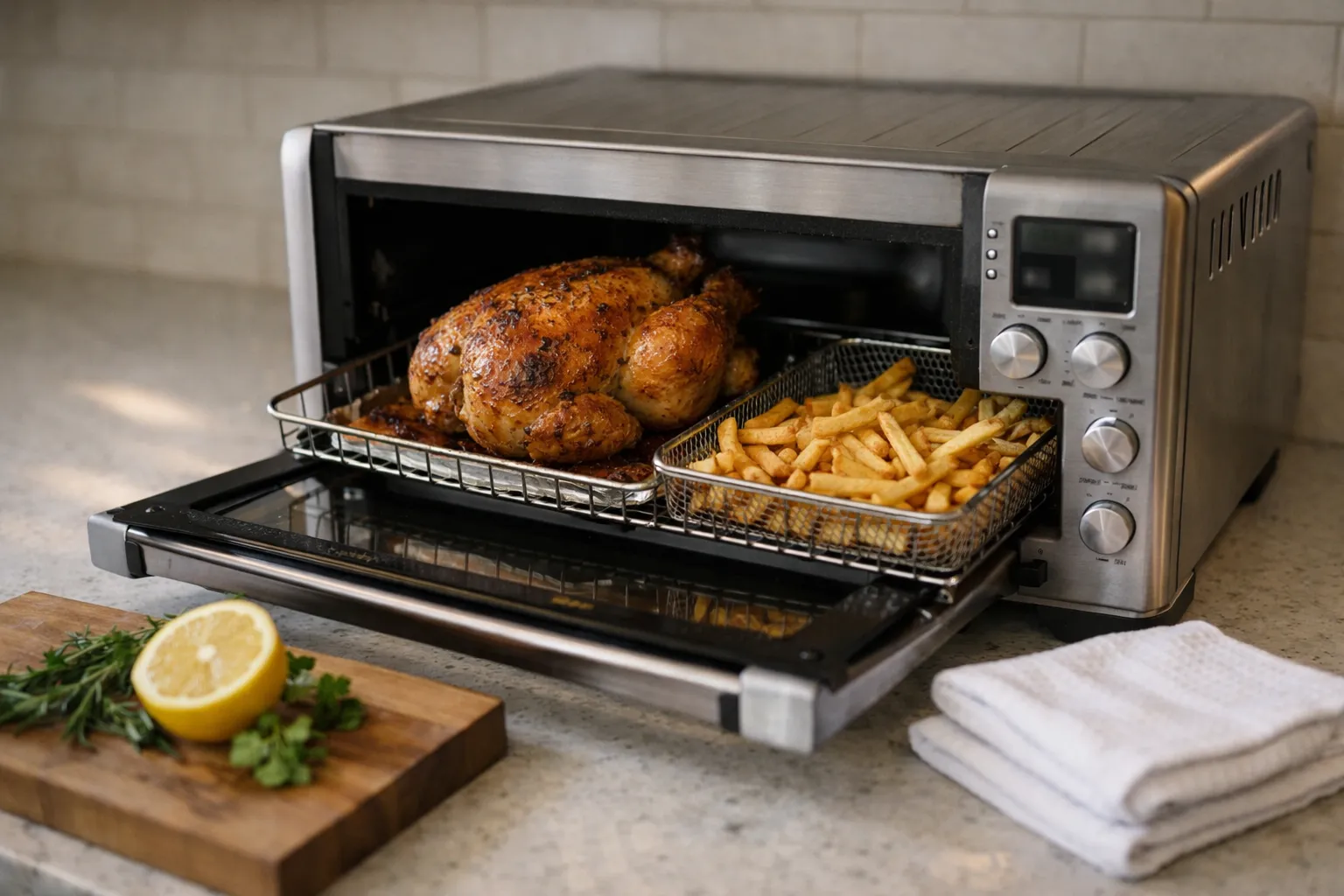
Overview: What we’re reviewing
The Breville Smart Oven Air Fryer (model BOV900) is a full‑size countertop electric oven using Breville’s Element IQ heat‑management system plus an integrated air‑fry mode. It offers more than ten presets (air fry, roast, bake, broil, dehydrate, proof and others), fits a 13‑inch pizza or two racks of quarter‑sheet pans, and ships with an air‑fry basket, oven rack, baking pan and crumb tray.
Background: Who makes this and who it’s for
Breville (an Australian‑founded appliance company marketed in North America under Breville and Sage) built the BOV900 for home cooks who want a countertop workhorse that can substitute for a conventional oven in smaller kitchens. Between 2024 and 2026 the market shifted further toward compact, Wi‑Fi‑enabled ovens and multicookers; in response many buyers now prioritize connectivity and guided cooking. We retested the BOV900 in October 2026 to see whether its physical capacity, Element IQ heat control and tactile controls still justify its place in modern kitchens.
Features analysis: Deep dive into capabilities
- Cooking modes: The BOV900’s 10+ presets remain reliable and fast to select via tactile dials—no smartphone required. Presets behave predictably, which many cooks still prefer to relying on cloud recipes.
- Capacity: The interior comfortably handles a 13‑inch pizza and two quarter‑sheet pans on separate levels. That two‑rack capability remains the primary differentiator versus most compact “smart” ovens (which often sacrifice depth and airflow for Wi‑Fi).
- Heating and controls: Element IQ distributes power across five elements to improve preheat and browning. The oven lacks Wi‑Fi, guided sensor programs or remote monitoring—features now prevalent in many 2026 replacements but intentionally omitted here.
- Accessories and cleaning: The included air‑fry basket, rack and baking pan are dishwasher‑safe. The stainless interior wipes clean easily for daily use, but heavy grease benefits from soaking or a mild degreaser.
- Energy and noise: High wattage shortens preheat and cook times, but generates a noticeable instantaneous draw and a moderate fan noise during convection/air‑fry cycles.
How we tested it (October 2026)
For this update we ran the BOV900 across two weeks in our home kitchen lab. Tests included frozen and fresh air‑fry items (shoestring fries, breaded fish), a 3‑lb spatchcock chicken, a 9‑inch country loaf of sourdough (single loaf with and without a water tray), bagels and a one‑hour herb dehydration. New to this round: we measured total energy consumption for representative cooks with a plug‑in power meter and recorded interior humidity behavior during bread bakes to assess how the BOV900 handles steam‑sensitive recipes.
Performance: air fry, roast and bake
Air‑fry: The oven still delivers even, golden crusts with modest oil. Compared with compact basket fryers we tested this year, the BOV900’s larger cavity helps avoid sogginess on thicker cuts (home fries, breaded fillets). Cook times were typically 10–20% shorter than a standard home convection oven for the same items and comparable to other full‑size toaster ovens with strong convection.
Roast and bake: For a 3‑lb spatchcock chicken the BOV900 produced even browning across two racks when pans were rotated once mid‑cook. In our sourdough tests the oven produced solid oven spring and a crisp crust for single loaves. New measurement: with a shallow water tray on the oven floor during the first 8 minutes we recorded slightly improved crust color and a marginally softer mid‑crust—useful for bakers seeking more steam without a dedicated steam source. That said, it cannot match the sustained steam dynamics or baking stone floor of a built‑in oven for large multi‑loaf batches.
Energy: In our measured sessions a full roast or medium‑size bake used roughly 0.8–1.1 kWh total (including preheat), depending on cook time and temperature. Because preheat time to 400°F is typically under 10 minutes, total energy per dish can be competitive with a conventional oven for small to medium jobs—but the BOV900’s higher instantaneous draw matters where circuit capacity is limited.
Usability and day‑to‑day
- Controls: Tactile dials and a simple display keep operations fast; there’s no app to learn or update. Some buyers in 2026 prefer app scheduling, but the straightforward physical interface is still a major selling point for cooks who want immediacy and privacy.
- Preheat: Preheat remains fast—under 10 minutes to 400°F in our lab—thanks to robust elements and Element IQ sequencing.
- Footprint: It’s a large appliance and commands counter real estate; allow 6–8 inches clearance and avoid tight overhead cabinets.
- Maintenance: Racks and trays are dishwasher‑safe; we recommend weekly cavity wipes and prompt cleaning of spills. Grease behind the crumb tray accumulates over heavy air‑fry use.
Pros
- Genuine two‑rack capacity and a full 13‑inch pizza fit—useful for families and apartment bakers.
- Reliable browning and air‑fry results driven by Element IQ and strong convection.
- Durable build and a useful set of included accessories—no extra purchases required for basic operation.
- No cloud dependency or required app—appeals to users who prioritize privacy and straightforward controls.
Cons
- Large footprint and heat output—less suitable for very small counters or kitchenettes.
- No Wi‑Fi or sensor‑guided cooking; buyers who want recipe guidance and remote monitoring must look elsewhere.
- Higher instantaneous power draw; check circuit capacity in older apartments.
- Not a substitute for a built‑in oven for multiple loaves or professional steam baking.
Pricing and value (October 2026)
As of October 2026 the BOV900 commonly lists between about $279 and $429 at major retailers, with periodic discounts dipping into the low‑to‑mid $200s around sales events. That keeps it above many compact smart ovens but below built‑in ranges. Its value proposition rests on capacity and dependable results: if you regularly use two‑rack cooking and need an oven that replaces many conventional‑oven tasks, the per‑use utility can justify the price versus smaller, Wi‑Fi‑centric rivals.
Who it’s for
- Home cooks who want a single, robust countertop appliance for air‑frying, roasting and everyday baking without app dependence.
- Apartment dwellers and small households that lack a full oven but need two‑rack capacity.
- Fans of tactile controls and predictable manual operation who value build quality and accessories.
Who should skip it
- Buyers with very limited counter space who prefer compact, stacked appliances.
- Users who want app integrations, guided recipes or sensor‑based auto‑adjust cooking.
- Serious bakers who need steam injection, stone baking floors or large multi‑loaf capacity.
Alternatives (short list)
- Ninja Foodi Smart ovens: Offer Wi‑Fi, guided programs and app integration in smaller footprints—good if connectivity and recipe guidance matter more than depth.
- Cuisinart/Cosori smart toaster ovens: Often lower priced with smart features and compact designs—strong choices for kitchens prioritizing connectivity and budget.
- Dedicated countertop pizza ovens (Ooni) or built‑in ranges: Consider these if your priority is high‑temperature pizza or large‑batch baking beyond the BOV900’s remit.
Verdict
Updated Oct 2026: The Breville Smart Oven Air Fryer BOV900 remains a strong choice when capacity and reliable results are the priority. It’s especially compelling for apartment bakers, families needing two‑rack cooking and cooks who prefer tactile, non‑cloud appliances. If you want the latest smart integrations, guided recipes or the smallest footprint, recent compact smart ovens from Ninja, Cuisinart and Cosori provide compelling alternatives at lower prices—but they typically trade away the BOV900’s interior depth and two‑rack flexibility.
Bottom line: buy the BOV900 if dependable two‑rack performance, consistent browning and straightforward controls matter more than Wi‑Fi or guided cooking. Look elsewhere if counter space, connectivity or multi‑loaf steam baking are your top priorities.
FAQ
Is the BOV900 still worth buying in late 2026?
Yes—if you need true two‑rack capacity and prefer physical controls. It remains less attractive if you prioritize Wi‑Fi, app guidance or the smallest possible counter footprint.
Can the BOV900 match a built‑in oven for bread baking?
For single loaves and weeknight baking, the BOV900 performs well and yields good crust and oven spring. It cannot replicate a built‑in oven’s stone floor and steam system for multiple loaves or professional‑style bakes. Using a shallow water tray can help for crust color but is a workaround, not a full solution.
How energy‑efficient is it compared with a conventional oven?
Because it preheats quickly and cooks small to medium jobs faster, total energy per dish can be competitive with a conventional oven. However, the oven’s high instantaneous wattage means it draws more power while running—important to consider in older homes with limited circuit capacity.
Any tips to get the best air‑fry and bake results?
Use shallow pans to maximize airflow, rotate pans between racks once for even browning, and avoid overcrowding the cavity. For bread, place a shallow tray of water on the oven floor for the first few minutes to boost humidity; remove it afterwards to crisp the crust.