
Overview: What we’re analyzing and why it matters now
Olive oil remains a small but emotionally and financially significant grocery purchase: a high-impact ingredient that can elevate a dish or waste money when flavor and freshness have been lost. As of August 2026 the market is calmer than the acute shocks of 2022–24, but new forces — more transparent traceability tools, growing domestic premium production, and renewed regulatory scrutiny — are reshaping how consumers get value. This update explains what changed since June 2026, highlights concrete signals to look for on the shelf, and gives ROI‑focused rules so you don’t overpay for stale or misrepresented oil.
Background: What led to the current market dynamics
The structural drivers remain familiar: weather variability in Mediterranean producing regions, shifting acreage and yields, and supply-chain responses from importers and retailers. Since mid-2024 producers and packagers shifted strategies — better on‑farm practices where possible, more blending to stabilize supply, and increasing investment in tracing material back to the mill and harvest. Two developments accelerated in the first half of 2026 and matter for shoppers now:
- Traceability went mainstream for some brands. Several premium and mid‑market brands and a growing number of retailers now publish harvest or crush dates and batch-level test results via QR links or label text. That doesn’t mean universal transparency, but it makes it easier to find genuinely fresh bottles without guessing.
- Domestic premium production rose in visibility. California, Chile and Australia — already visible in 2025 — are increasingly marketed on flavor and harvest timing rather than origin as a sticker. That gives shoppers real alternatives to traditional Mediterranean single-estate claims, but it also demands careful label reading because marketing language has proliferated.
Data and evidence: Prices, production, testing and traceability
1) Prices: easing from the peak but still a premium category
Across 2025–26 wholesale and retail prices moderated compared with the 2022–24 spikes as higher-yield pockets were harvested and importers worked through older, higher-cost inventory. Retail prices are now more variable by brand and channel: discount chains are promoting lower-cost blended oils while specialty grocers price early‑harvest, high‑phenolic EVOOs as premium items. For shoppers, the practical takeaway is unchanged: expect to pay a meaningful premium for clearly dated, test-backed extra‑virgin oil compared with anonymous, mass-market bottles.
2) Production and sourcing: more origin options — with labeling complexity
Traditional producers (Spain, Italy, Greece, Tunisia) still supply the bulk of global trade, but New World and non-traditional suppliers increased commercial share and marketing muscle in 2026. That helps supply resilience but complicates interpretation: "single‑origin," "estate," and multi-country blends carry very different implications for flavor and price. Labels often mix provenance claims and packing-country language; be skeptical when origin language is vague.
3) Authenticity testing: ongoing concerns, smaller wins
Independent lab testing and regional certifiers continued sampling through 2025–26. The chief consumer losses reported consistently are not large-scale substitution with seed oils but quality failures: oils sold as EVOO that are oxidized, blended without transparent disclosure, or past reasonable freshness windows. Where labs find non‑compliance, it tends to cluster in low‑priced, high‑volume products where supply pressure and margins are tight. That pattern means consumers lose flavor and health-value most often by buying the wrong bottle for the use case, not because bottles are actively dangerous.
4) Traceability tools: QR codes, harvest dates and third‑party seals
What changed most in 2026 is accessibility of batch-level info. A growing set of producers link bottles to harvest dates, mill names and simple lab markers via QR codes or label text. Regional certifiers (for example, the California Olive Oil Council and several PDO groups in Europe) widened testing programs and urged clearer harvest dating as a differentiator. But adoption is uneven: many supermarket private labels still lack harvest dates or lot information.
Multiple perspectives: how stakeholders read the market
Producers and exporters
Growers say the market is stabilizing but emphasize continued cost pressure from testing, logistics and climate adaptation. Many justify premium pricing for clearly labeled early‑harvest oils on the basis of lower yields and higher polyphenol profiles; they also note that robust traceability programs add real cost that is reflected at retail.
Retailers and buyers
Retail buyers report two distinct consumer tracks: price‑sensitive shoppers who prioritize cost-per-ounce and convenience, and an expanding cohort willing to pay for flavor transparency (harvest date, mill). Some retailers are using private‑label early‑harvest runs to capture the premium segment, but that requires investment in supply relationships and testing to defend claims.
Consumer testers and advocacy groups
Testing programs continue to push for standardized labeling (harvest date, country of origin, and lot/pack date). Consumer advocates caution shoppers that QR codes are useful only if they disclose meaningful batch-level data — a code that links to marketing text adds little. The practical call is the same as before: demand harvest dates and prefer third‑party seals or published batch tests.
Implications: Practical, ROI-focused shopping and storage rules (updated)
For adult cooks investing limited time and grocery dollars, the optimal strategy is explicit: buy the right oil for the intended use, prioritize freshness for raw applications, and protect your purchase after opening. Below are updated, actionable steps that reflect 2026 realities.
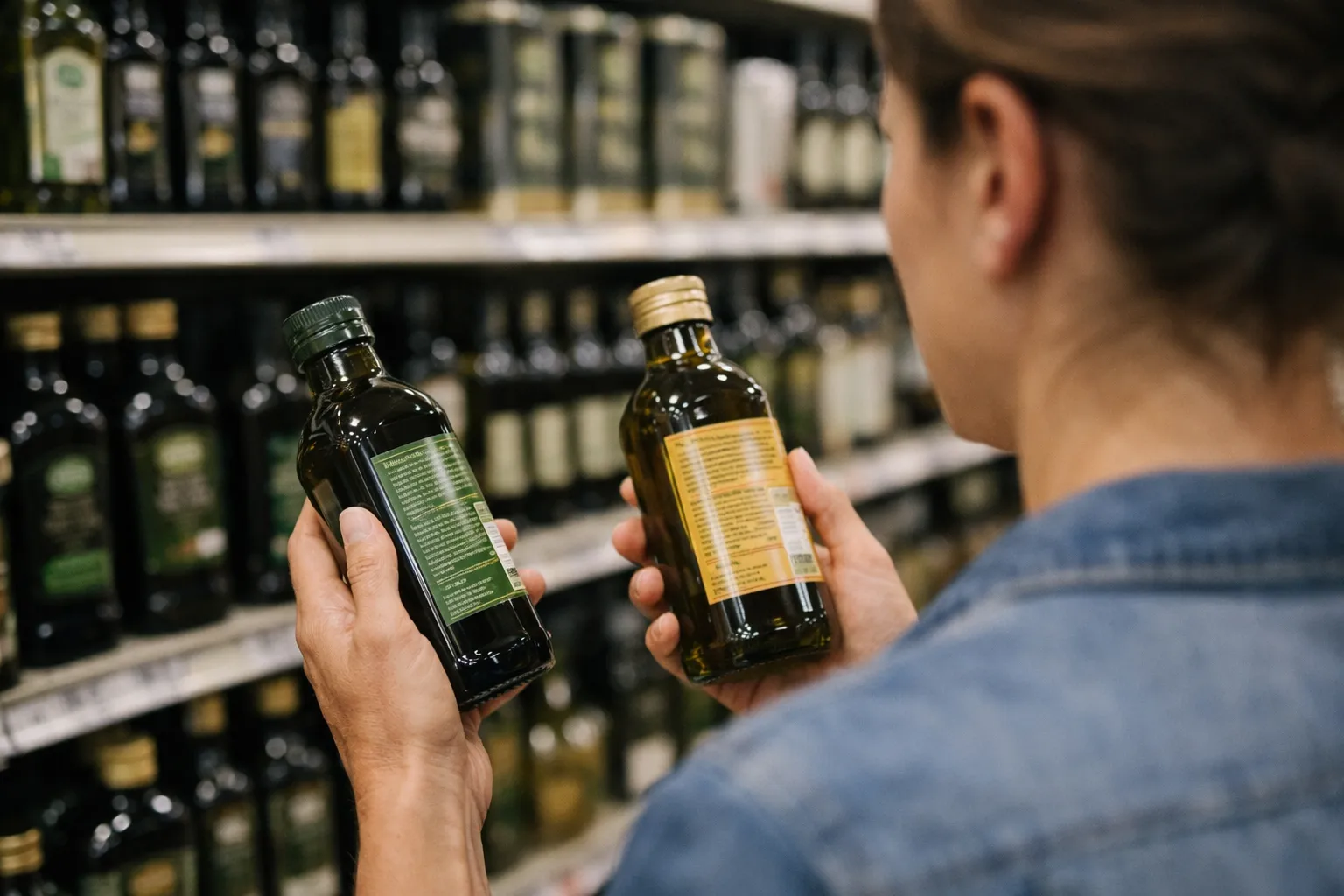
1) The 30‑second label check — now with harvest/pack priorities
- Harvest/crush date is the key freshness marker. Prefer oil harvested within 9–12 months for finishing; for premium early‑harvest bottles (strong peppery, green flavors), target under 9 months if you want the expected intensity. If no harvest or pack date is listed, assume lower likelihood of peak flavor.
- Origin wording: "Product of" or "Olives grown and pressed in" means the production country. "Packed in" or "Bottled in" only reveals the bottling location.
- Look for mill/lot numbers and QR links that disclose batch tests. Follow the QR and confirm at minimum a harvest date and simple quality markers; absence of that detail lowers the bottle's transparency rating.
- Container matters: tins or dark glass remain best. If a clear bottle is the only option, buy small and plan to use quickly.
2) Match quality to cooking purpose — stricter tiers for 2026
- Raw finishing (salads, drizzle): pay for recently harvested, sensory‑verified EVOO. The flavor ROI on a small fresh bottle is high.
- Everyday cooking (sauté, roast): mid‑priced, clearly labeled blended EVOO or a standard EVOO is appropriate; no need to buy early‑harvest for these tasks.
- High‑heat frying: use refined olive oil or a neutral high‑oleic alternative to preserve budget and smoke-point performance.
3) Storage and decant strategies to protect your investment
- Store unopened tins or bottles in a cool, dark place — not over the stove. Retail storage also matters; avoid bottles in warm, sunlit supermarket displays if possible.
- After opening, transfer bulk tins to a dark glass or stainless steel dispenser for daily use and keep the bulk container sealed. That minimizes air and light exposure.
- Open high‑flavor bottles only when you plan to finish them in 3–6 months; less aggressive oils can last longer but lose peak taste over time.
4) Low‑cost authenticity filters and sensory checks
Sensory checks remain the most practical tool: a fresh EVOO should show green or fruity aromas and a pleasant bitterness/peppery finish for high‑phenolic oils. If a bottle smells flat, waxy, or like stale cardboard, it’s likely oxidized or low in polyphenols — not dangerous, but a flavor and value failure. Use those bottles for cooking and replace your finishing oil.
Outlook: What to watch through late 2026 and into 2027
- Retail transparency adoption: Watch whether harvest dating becomes standard for mid‑market brands. Wider adoption would simplify comparison shopping and raise the baseline for flavor-related ROI.
- Regulatory and enforcement activity: Expect more targeted enforcement actions where consumer test results show recurring mislabeling. Consumers should look for brands that proactively publish batch results or are tied to credible certifiers.
- Premium segmentation: The premium early‑harvest market will likely deepen, with more small producers marketing high‑polyphenol oils. That’s good for flavor seekers but increases the need to verify harvest dates and batch testing.
Bottom line: In August 2026 the best olive oil strategy remains ROI-driven: spend more where flavor matters, insist on harvest/lot transparency when you pay a premium, buy smaller fresh bottles for finishing, and store opened containers to minimize quality loss. Transparency is improving for motivated shoppers, but uneven adoption means you still must read labels and use sensory checks rather than rely on packaging alone.
FAQ
How much more should I expect to pay for reliably fresh EVOO in 2026?
Expect to pay a noticeable premium for bottles that list a recent harvest/crush date, batch tests or mill information versus anonymous mass-market options. The premium reflects lower-yield harvests, testing and traceability costs; whether it’s worth it depends on how you use the oil. For raw finishing, the flavor ROI usually justifies the extra cost; for frying, it does not.
Are QR codes sufficient proof of authenticity?
No. A QR code is a tool, not proof. Use it to check whether it links to batch-level data: harvest/pack date, mill/lot number and basic lab markers or a third‑party seal. If the QR only leads to marketing text or a brand story, it adds little to your confidence.
Is old or rancid-tasting olive oil unsafe to eat?
Generally no — oxidized oil is not usually a food‑safety hazard, but it loses the flavor and the polyphenol benefits that justify paying more. Use rancid-tasting oil for high‑heat cooking (where flavor is masked) and replace bottles you rely on for finishing.
Should I buy tins or small bottles in 2026?
Buy tins if you consume oil regularly and can decant into a small dark dispenser for daily use; that gives you better value per ounce. If you’re an infrequent user or buying a high‑flavor early‑harvest EVOO, smaller bottles are a safer ROI because they’re likelier to be consumed while fresh.
What are the simplest signals of a good value bottle?
Look for a clear harvest or pack date within 9–18 months (shorter for high‑flavor oils), a dark container or tin, and either a mill/lot number or a QR link that reveals batch information. Match price to intended use: spend more for raw finishing and less for high‑heat cooking.